Direct Consultation
"The 2026 migration landscape is complex. Our Brisbane team simplifies the pathway for skilled professionals."
Check Eligibility Now

"The 2026 migration landscape is complex. Our Brisbane team simplifies the pathway for skilled professionals."
Check Eligibility NowAs of 1 March 2026, the application fee for the Australian 485 Temporary Graduate visa has doubled to AUD 4,600 for primary applicants, a move aimed at enhancing the integrity of the migration system. Meanwhile, the Subclass 500 Student visa fee remains starting from AUD 2,000. Significant updates for 2026 include more rigorous Genuine Student (GS) assessments, a new age limit of 35 for 485 visa applicants, increased English language benchmarks (IELTS 6.5), and the 100% surge in graduate visa costs.
Subclass 485 Visa Fee: Increased from AUD 2,300 to over AUD 4,600 for main applicants, starting 1 March 2026.
Dependent Fees: Now set at AUD 2,300 for partners and AUD 1,150 for children.
485 Age Limit: Capped at 35 years of age or younger for the majority of candidates.
English Requirement: Raised to a minimum of IELTS 6.5 (or an equivalent score).
Subclass 500 Fee: Pricing begins at AUD 2,000, accompanied by more stringent Genuine Student (GS) evaluations.
Cost: Starting from AUD 2,000.
Purpose: Allows for academic study in Australia for a maximum of 5 years.
Key Requirements: Valid Confirmation of Enrolment (CoE), satisfaction of Genuine Student (GS) standards, Overseas Student Health Cover (OSHC), and verified English competency.
Cost: AUD 4,600 or more (effective from 1 March 2026).
Duration: Typically ranges from 2 to 3 years, though Hong Kong and British National Overseas passport holders may stay for up to 5 years.
Streams: Includes Post-Higher Education Work, Post-Vocational Education Work, and Second Post-Higher Education Work (specifically for those in regional areas).
Conditions: Applicants must have possessed a student visa within the previous 6 months and satisfy English, medical, and skills assessment criteria.
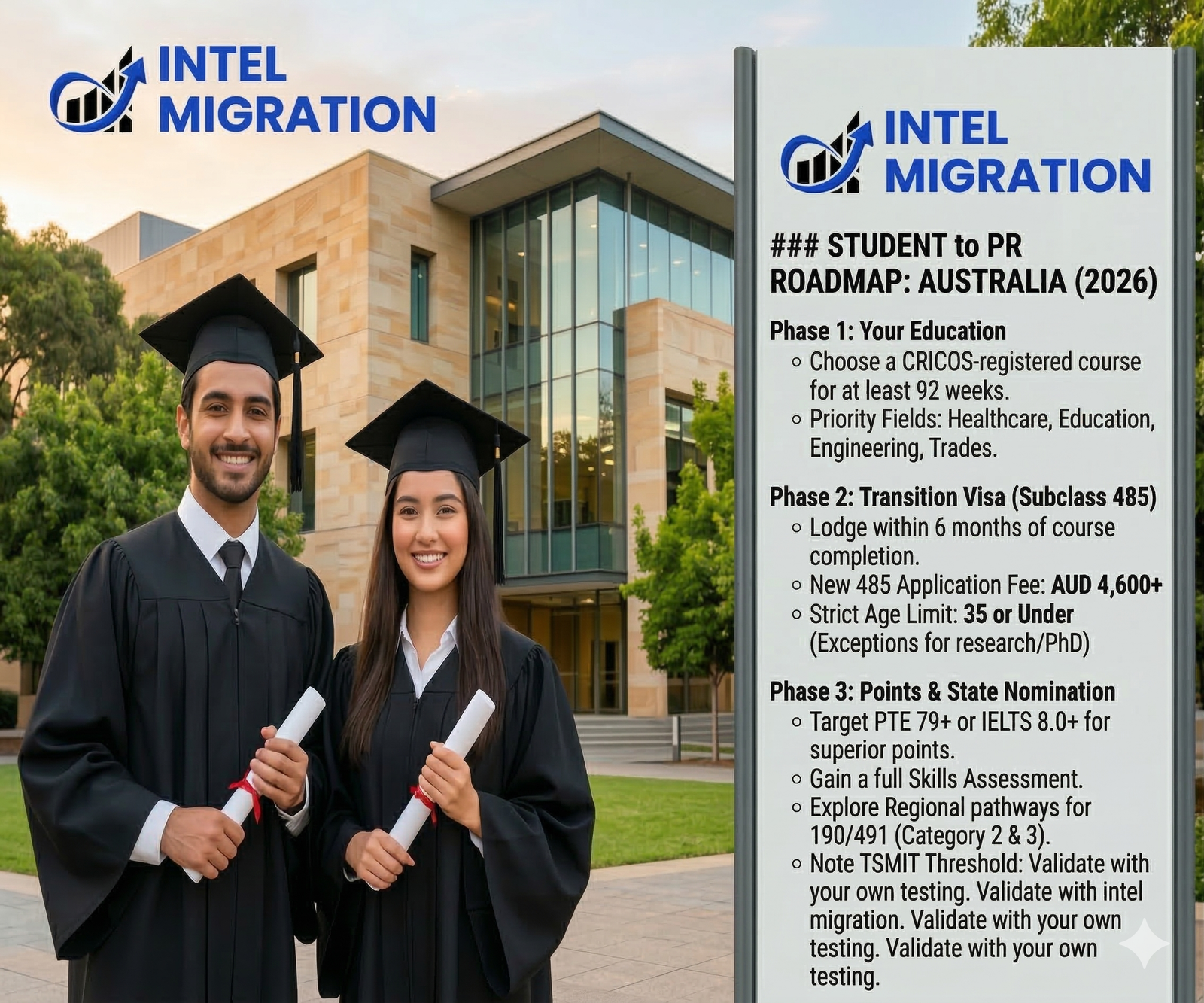
Study: Finish a CRICOS-approved course lasting at least 92 weeks.
485 Visa: Submit an application within 6 months of completing your studies.
Skills Assessment: A necessary step for both 485 and permanent residency applications (costing between $500 to $1,500).
Work/English: Accumulate relevant Australian professional experience and target superior results in PTE or IELTS exams.
PR Visa: Work toward securing a 189, 190, or 491 visa.
Note: The Temporary Skilled Migration Income Threshold (TSMIT) is scheduled to rise to $79,499 effective 1 July 2026.
The “Student to PR” pipeline is the most common route for international talent to call Australia home. It usually involves two distinct stages. First, the Subclass 500 (Student Visa) allows you to complete your CRICOS-registered course while maintaining limited work rights. Second, the Subclass 485 (Temporary Graduate Visa) acts as the vital “bridge,” giving you the right to work full-time in Australia after you graduate to gain the local experience required for a points-based invite.
In 2026, the Australian Government has tightened these pathways to ensure that students are “genuine” and that graduates are filling real skill gaps in the workforce. This means your choice of course is now more linked to your PR prospects than ever before. If you are confused about which stream fits your profile, intel migration can provide clarity on the latest legislative instruments.

The most significant change in early 2026 has been the “price of entry.” On 1 March 2026, the Department of Home Affairs implemented a significant increase in the Visa Application Charge (VAC) for graduate visas. The goal of this policy is to manage the volume of applications and ensure that those staying on are committed to joining the skilled workforce in high-demand sectors.
| Visa Subclass | Base Fee (Main Applicant) | Dependant (18+) | Dependant (<18) |
| Subclass 500 (Student) | $2,000 | $1,500 | $500 |
| Subclass 485 (Graduate) | $4,600 | $2,300 | $1,150 |
| Subclass 190/189 (PR) | $4,910 | $2,455 | $1,230 |
Note: These figures reflect the March 2026 updates. Always check the official Visa Pricing Estimator for credit card surcharges and annual indexation adjustments.
The jump to $4,600 for the 485 visa has been a shock to many. Because this is a non-refundable investment, a refusal due to a simple administrative error or an expired English test is now a very expensive mistake to make.
The student visa is no longer just about getting into an Australian classroom. The focus has moved toward “Genuine Students” who intend to use their education to contribute to the economy or return home with improved skills.
The old GTE (Genuine Temporary Entrant) statement has been replaced by a targeted set of questions within the application. You must prove that you understand your course, your future career path, and why Australia is the chosen destination for your specific goals. Generic “I love the Australian lifestyle” answers will likely result in a refusal.
To get your Subclass 500 granted, you must show you have enough money to support yourself without relying on local work. As of 2026, the minimum cost of living requirement is approximately $29,710 per year for a single applicant. This doesn’t include your tuition fees or travel costs. You will need to provide bank statements or loan documents that validate this amount.
If you have finished your studies, the 485 visa is your golden ticket to gaining the work experience required for PR. However, the rules changed significantly in mid-2024 and have been further refined throughout 2025 and 2026.
Post-Higher Education Work Stream: For those who completed a Bachelor’s, Master’s, or PhD. You generally do not need a skills assessment for this initial graduate visa.
Post-Vocational Education Work Stream: For those with diplomas or trade certificates. Your qualification must be on the Medium and Long-term Strategic Skills List (MLTSSL), and you must have a positive skills assessment from the relevant body.
The most controversial change is the age cap. Most applicants must be 35 years of age or under at the time of their 485 visa application. There are limited exceptions for Masters by Research and PhD graduates, who can apply up to the age of 50. If you are approaching your mid-30s, your timing must be perfect to ensure you lodge before your birthday.
The “bonus” extensions for certain degrees were rolled back in previous cycles. Currently, a Bachelor’s degree generally grants you 2 years, a Master’s (coursework) 2 years, and a Master’s (research) 3 years. If you study in a regional area like Adelaide, Hobart, or Townsville, you may be eligible for a second 485 visa later, giving you an extra 1 to 2 years of work rights.
Following a logical sequence is the best way to avoid visa “dead ends” and wasted fees.
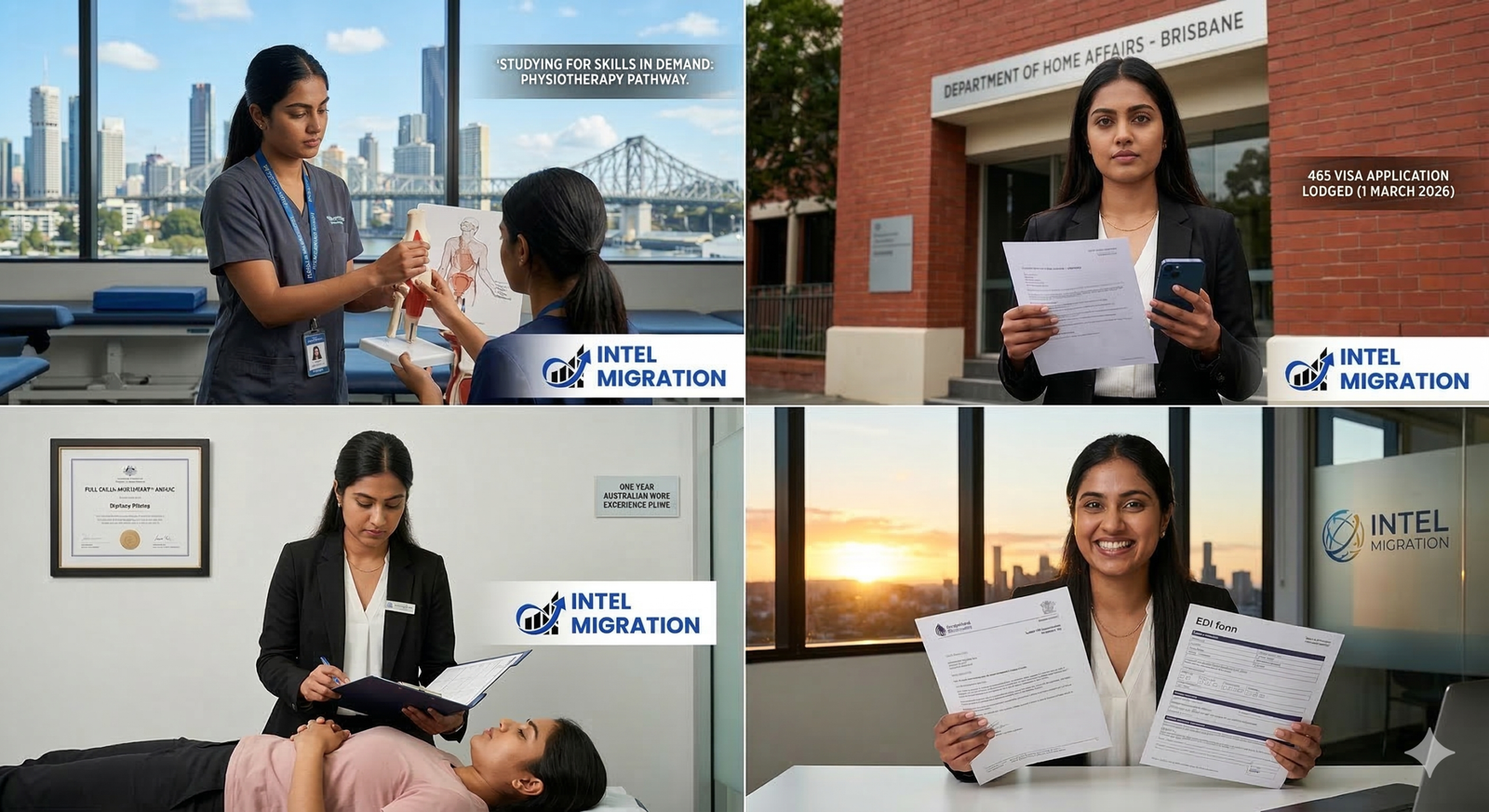
Don’t just pick a course because it is the cheapest option. Look at the Skills in Demand lists. Occupations in healthcare (Nursing, Physiotherapy), Education (Secondary or Early Childhood), and skilled trades (Carpentry, Plumbing) have the most consistent pathways to PR. Ensure your course is at least 92 weeks (2 academic years) to satisfy the Australian Study Requirement.
Apply for your 485 visa within six months of your course completion date. Ensure you have your English test results (IELTS 6.5 or PTE 55) and your Australian Federal Police (AFP) check ready before you lodge. With the fee now at $4,600, there is no room for “lodging now and figuring it out later.”
While on your 485 visa, you need to get a “Full Skills Assessment” from the relevant authority (like Engineers Australia, ACS, or ANMAC). This usually requires a combination of your degree and at least one year of post-grad work experience in Australia. Once you have this, you can submit an Expression of Interest (EOI) through the SkillSelect system.
Most students will look for a Subclass 190 (State Nominated) or Subclass 491 (Regional) invitation. In 2026, many states are prioritising “onshore” applicants who are already working in their nominated field. Alternatively, if you have a supportive employer, you might transition to a Subclass 186 (Employer Nomination Scheme) after two years of full-time work with them.
| The Mistake | The Consequence | The Fix |
| Applying for the wrong 485 stream | Immediate refusal with no refund. | If you have a Bachelor’s, use the Higher Education stream. If a Diploma, use the Vocational stream. |
| Missing the 6-month deadline | Loss of eligibility for a 485 visa. | Your 6-month window starts from the date on your Completion Letter, not your graduation ceremony. |
| Expired English Test | Invalid application. | For a 485 in 2026, your English test must be less than 12 months old at the time of lodgement. |
| Inadequate Health Insurance | Visa refusal. | You must hold Overseas Visitor Health Cover (OVHC) from the day you apply for the 485. Student OSHC is not sufficient. |
At intel migration, we often see applicants who wait until the last minute to book their English tests or health checks. In the current 2026 environment, “close enough” is not good enough for the Department.
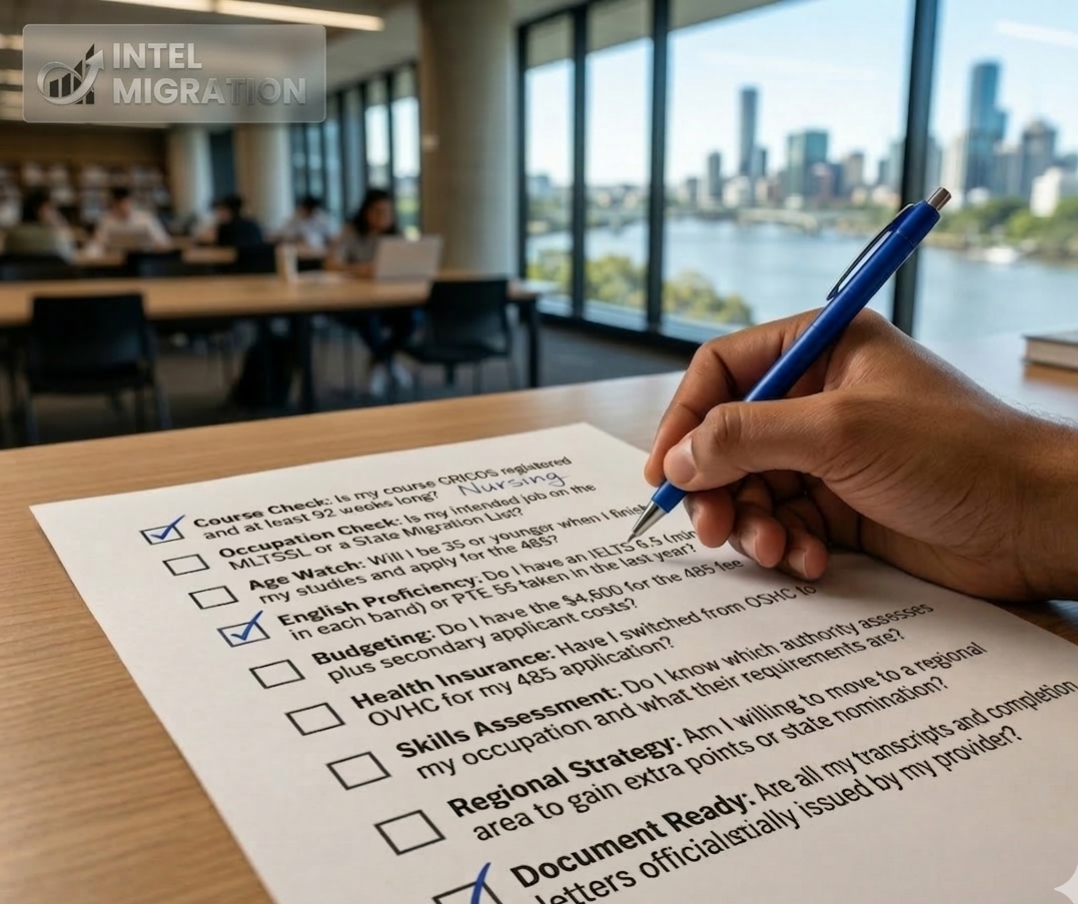
Use this list to ensure you are on the right track for your PR journey:
[ ] Course Check: Is my course CRICOS registered and at least 92 weeks long?
[ ] Occupation Check: Is my intended job on the MLTSSL or a State Migration List?
[ ] Age Watch: Will I be 35 or younger when I finish my studies and apply for the 485?
[ ] English Proficiency: Do I have an IELTS 6.5 (min 5.5 in each band) or PTE 55 taken in the last year?
[ ] Budgeting: Do I have the $4,600 for the 485 fee plus secondary applicant costs?
[ ] Health Insurance: Have I switched from OSHC to OVHC for my 485 application?
[ ] Skills Assessment: Do I know which authority assesses my occupation and what their requirements are?
[ ] Regional Strategy: Am I willing to move to a regional area to gain extra points or state nomination?
[ ] Document Ready: Are all my transcripts and completion letters officially issued by my provider?
1. Can I still get PR if my occupation isn’t on the priority list?
Yes, but it is significantly more difficult. You may need to rely on the Subclass 491 (Regional) visa or find an employer willing to sponsor you under a Labor Agreement, which often has broader occupation options than the standard skilled lists.
2. Why did the 485 visa fee increase so much in 2026?
The Australian Government adjusted the fee to $4,600 to reflect the high value of Australian work rights and to fund improvements in visa processing systems. It also serves as a policy mechanism to ensure that only those with a high likelihood of skilled employment apply.
3. I am 36 years old and finishing my Master’s. Can I get a 485 visa?
Generally, no. The age limit for the Post-Higher Education Work stream is now 35. However, if you are completing a Master’s by Research or a PhD, the age limit remains 50. If you do not fit those categories, you may need to look directly at employer-sponsored or state-nominated visas.
4. What is the difference between Subclass 190 and Subclass 491?
The 190 is a permanent visa from day one, allowing you to live anywhere in the nominating state. The 491 is a 5-year provisional visa that requires you to live and work in a regional area for 3 years before you can apply for PR via the Subclass 191.
5. How many points do I actually need for an invitation in 2026?
While 65 points is the legal minimum, the competitive nature of 2026 means most applicants in IT, Accounting, or Engineering need 85 to 95 points. For Nursing and Teaching, invitations are often issued at lower point scores due to high demand.
6. Can I include my partner on my 485 visa application?
Yes, you can. However, be aware that the fee for a partner is $2,300 in 2026. You must provide evidence of a genuine relationship, such as a marriage certificate or evidence of a de jure or de facto relationship lasting at least 12 months.
7. Does a “Professional Year” still give me points?
Yes, completing a Professional Year (PY) in Accounting, ICT, or Engineering still provides 5 points toward your skilled migration total. It also often helps satisfy the work experience requirement for certain skills assessments.
8. Is the PTE test easier than IELTS for the 485 visa?
Many students find the PTE Academic’s computer-based format more predictable, but “easier” is subjective. In 2026, you need a PTE score of 55 overall. Make sure your test is taken in-centre, as online versions are not accepted for visa purposes.
9. What happens if my 485 visa is refused?
Because the 485 fee of $4,600 is non-refundable, a refusal is a major financial loss. You may have the right to appeal to the Administrative Review Tribunal (ART), but this is a long and expensive process. It is vital to lodge a “decision-ready” application.
10. Can I work on my student visa while waiting for the 485?
Once you have finished your course and applied for the 485, you will usually be granted a Bridging Visa A (BVA). While the student visa is still active, you must follow its work conditions. Once the BVA takes effect, you generally have full work rights.
11. Does studying in Sydney or Melbourne help with PR?
Studying in major cities provides great education, but it does not give you the “Regional Study” points. Students in regional areas (Category 2 and 3 locations) get 5 extra points and access to longer post-study work visas.
12. How long does it take to get PR after finishing a degree?
The timeline varies, but a typical path takes 3 to 5 years. This includes 2 years on a 485 visa to gain experience and the 6 to 12 months it takes for the Department to process a 190 or 189 visa once you are invited.
13. Can I apply for a 485 visa more than once?
Generally, you can only hold a 485 visa once as a primary applicant. The exception is for those who studied and worked in a regional area, who may be eligible for a second 485 visa. You cannot “reset” this by doing another course.
14. What are the “Skills in Demand” sectors for 2026?
The government currently prioritises Healthcare, Early Childhood and Secondary Education, Construction, and Green Energy sectors. Occupations in these fields often receive invitations with lower point scores and faster processing times.
15. Is a skills assessment required for the Student Visa?
No, you do not need a skills assessment for the Subclass 500. However, having a clear understanding of the assessment requirements for your future career is part of being a “Genuine Student” and helps with your long-term PR strategy.

Securing permanent residency in Australia in 2026 is no longer a matter of simply “waiting your turn” in a queue; it is about demonstrating immediate economic value and alignment with national workforce priorities. With the recent overhaul of the visa processing system and the implementation of standardised timelines, the government has made the path faster for those who are highly skilled and well-prepared, while making it significantly more difficult for those without a clear strategic plan. The doubling of graduate visa fees and the strict 35-year age limit underscore a clear policy shift: Australia is looking for long-term contributors who can fill critical gaps in healthcare, trades, and education. By focusing on high-demand occupations, maintaining superior English proficiency, and considering regional opportunities, you can successfully navigate these higher hurdles. While the landscape is more competitive, the rewards of life in Australia remain as high as ever for those who take the time to organise their journey correctly. For any further guidance on how these 2026 changes impact your specific situation, feel free to contact us to ensure your migration strategy is robust and decision-ready.